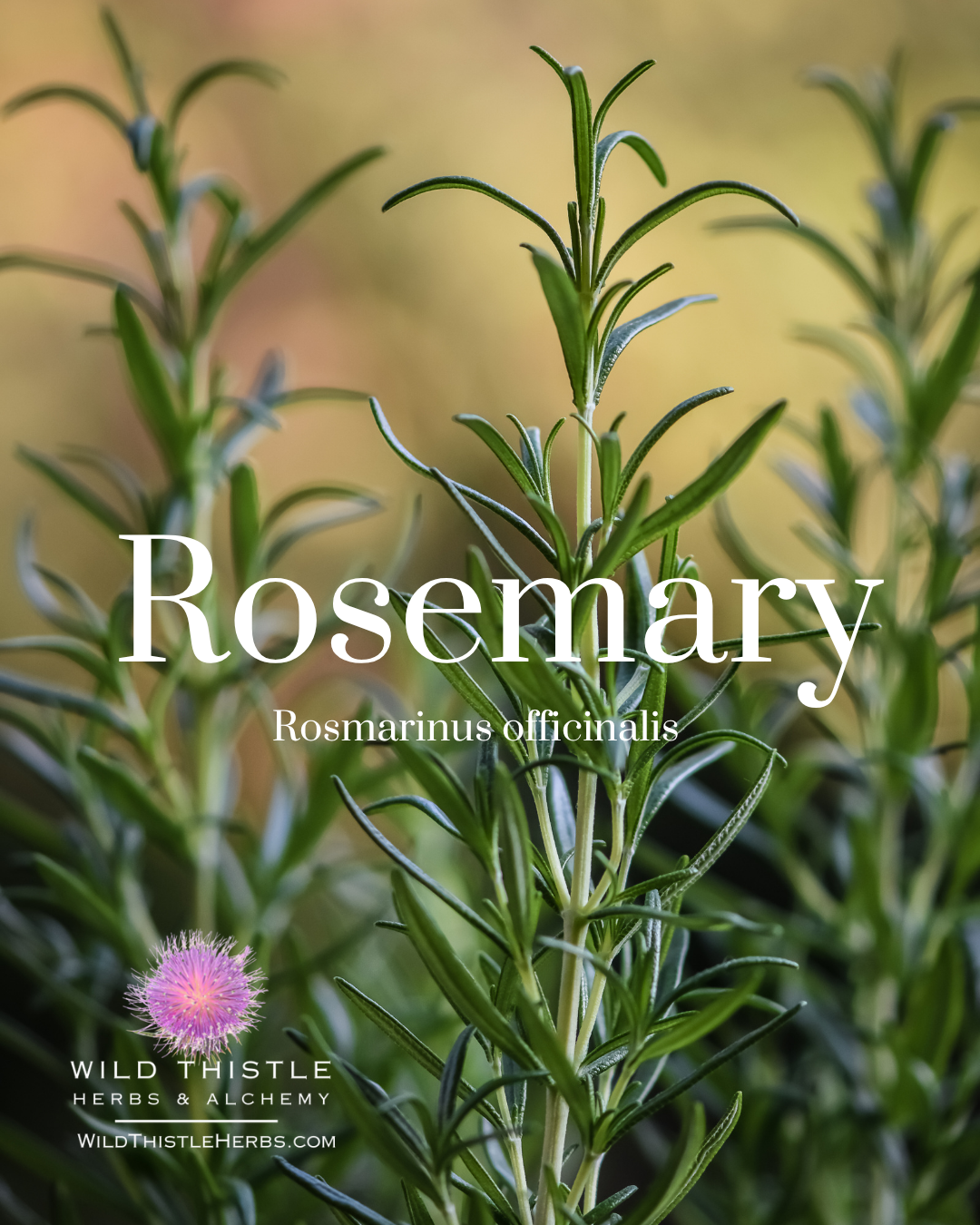
Rosemary
Herb Lore: Rosemary
Herb Lore is a recurring series here on the Wild Thistle blog where I explore the history, folklore, and magic of the plants I love and work with. Each entry is an invitation to see the herbs around you a little differently, not just as ingredients, but as ancient companions with stories worth remembering.
There is a plant that has followed humanity through temples and kitchens, through grief and celebration, through the sacred and the everyday. She is ancient, aromatic, and deeply familiar. She is rosemary.
I love rosemary for so many reasons, but perhaps most of all because she refuses to be only one thing.
She is culinary and she is holy. She is a kitchen staple and a sacred offering. She is the herb tucked into a roasting pan and the herb laid across an altar. She is needle-leafed and silver-green, growing into great fragrant bushes when she is happy and well-tended. When you brush past her in the garden, she announces herself immediately, that unmistakable clean, resinous scent rising up to meet you like a greeting from an old friend.
And she has been greeting us, friends, for a very long time.
She Was Sacred Before She Was Familiar
In French antiquity, rosemary was called l'incensier, the incenser, because her branches were burned as incense. Long before the herb jars and spice racks of the modern world, she was smoke and prayer, her fragrance rising upward as an offering. She belonged to the sacred space, not just the hearth. And that tradition is not as far from us as it might seem. In a recent class here at the apothecary, rosemary was one of the plants students reached for instinctively when crafting their own incense blends. Some things, it turns out, do not need to be taught. They are simply remembered.
The Devotion of the Journey
Legend says that during the Holy Family's journey into Egypt, Mary rested beneath a rosemary bush and spread her cloak across its branches to dry. The flowers, once white, turned blue in the color of her mantle. The Spanish name for rosemary is romero, born from this legend and rooted in the devotion of those who have always carried her close on long and sacred roads. Sacred to Mary, sacred to the journey, sacred to refuge in uncertain times.
There's Rosemary, That's for Remembrance
And then there is Shakespeare, who knew exactly what rosemary meant and placed her in the trembling hands of Ophelia. In Hamlet, as Ophelia moves through her grief, she offers a sprig of rosemary and speaks the words that generations have carried with them since: "There's rosemary, that's for remembrance."
She did not choose that plant by accident. Rosemary has long been the herb of memory and mourning, carried at funerals and laid at graves, woven into wedding garlands, pressed between the pages of letters. She sits at the threshold between what was and what is, holding the thread between the living and those who have gone before.
I think that is part of her deep magic. She asks us to remember. Not to be frozen in the past, but to carry what mattered forward.
She Is Enduring
In the garden, she is a generous and sturdy presence, those needle-thin leaves dense along woody stems, tiny flowers appearing in soft blues and purples that the bees adore. She is drought-tolerant and sun-loving, and in a happy spot, she will grow into something that commands attention. There is nothing fragile about rosemary. She is enduring.
In the kitchen, she brings her bold, resinous warmth to everything she touches. In the apothecary, she offers herself in other ways, a subject for another day and another post. And in the practice of plant spirit and magical work, she is a protector, a remembrancer, a companion for ritual, for cleansing, for honoring the ones we have loved and lost.
She has been smoke in a cathedral. She has been shelter for the holy. She has been grief held gently in trembling hands.
She is rosemary, and she is extraordinary.
Burn Her Yourself
If rosemary's story as l'incensier has you wanting to experience her as sacred smoke firsthand, I would love to bring a private incense crafting workshop to you. These are an intimate, hands-on experience working with plants just like her. You can learn more and reserve your spot at wildthistleherbs.com/private-incense-crafting-workshops.
These statements have not been evaluated by the Food and Drug Administration. This product is not intended to diagnose, treat, cure, or prevent any disease.