Basil
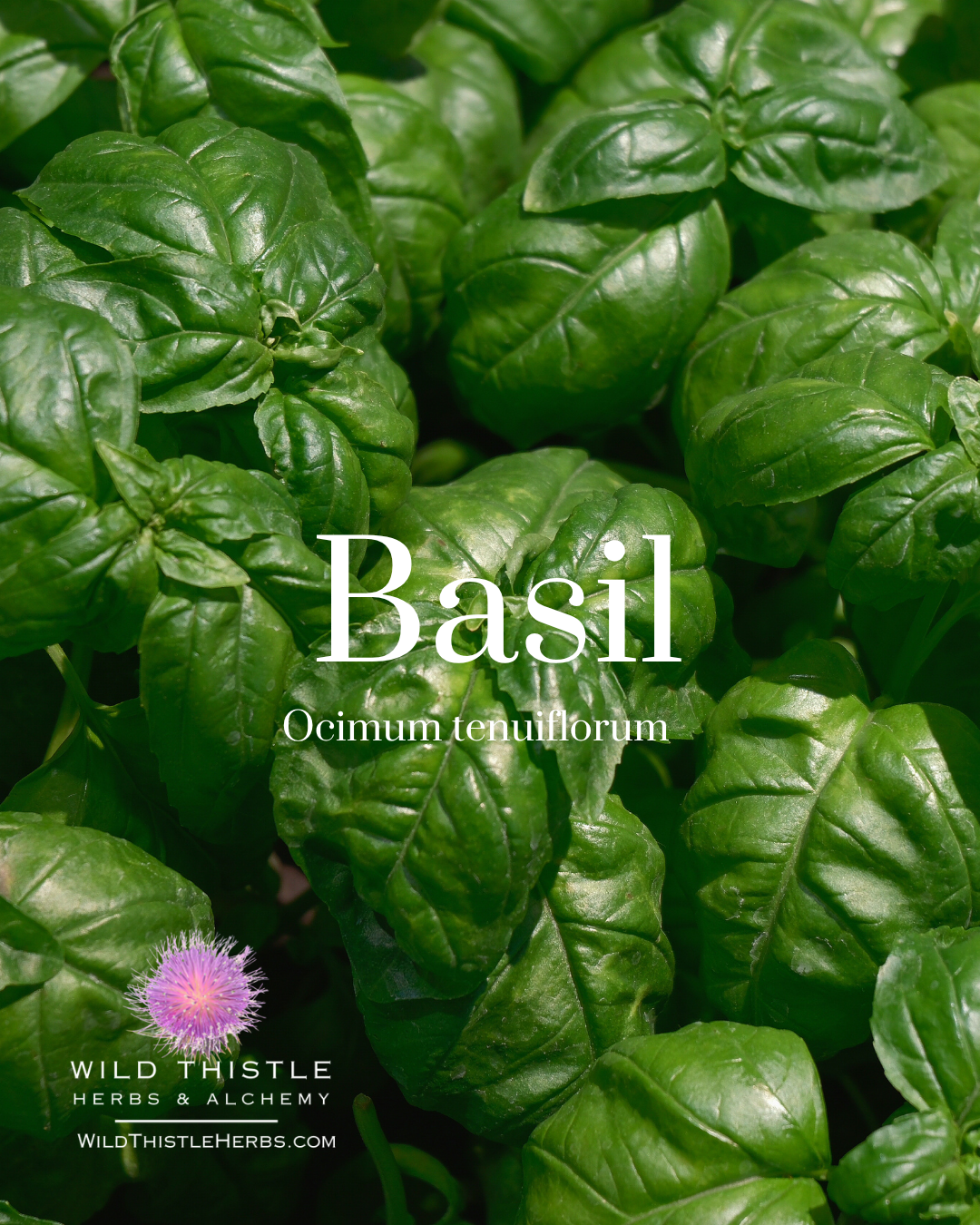
Herblore is a recurring series here on the Wild Thistle blog where I explore the history, folklore, and magic of the plants I love and work with. Each entry is an invitation to see the herbs around you a little differently, not just as ingredients, but as ancient companions with stories worth remembering.
HERBLORE: Basil
Basil is a plant that has been called both holy and evil, royal and cursed, an offering to the dead and a charm for love. She is ancient, aromatic, and impossible to forget.
Basil has been part of human life longer than we have had a written record to preserve her, and perhaps that is exactly why her lore is so tangled, so contradictory, and so rich. She is a member of the mint family, deeply aromatic, and I sometimes wonder if that very fragrance is part of why she has gathered so much story around her. A plant that aromatic is simply hard to forget, and humans, it seems, have never stopped trying to make sense of her.
Holy and Sacred
In India, Holy Basil, known as tulsi, is treated as sacred and is often grown in temple gardens. She is associated with divinity itself, connected to the goddess Lakshmi, and welcomed into homes as a living symbol of the divine. This reverence for basil as sacred is not unique to India. In the Greek Orthodox tradition, sweet basil is still used today as a purifying herb in the preparation of holy water.
Royal, Then Reviled
In ancient Greece, basil was once called the royal herb, an honor likely tied to her name itself. The word basil descends from basileus, the Greek word for king. Yet that royal reputation existed alongside a much darker one. In Crete, basil was associated with death and, by some, believed to belong to the Evil One. Elsewhere in Europe, she was considered a witch's herb. The Greeks and Romans alike once believed she could cause madness. It is a striking contradiction, a plant simultaneously fit for kings and feared as cursed.
A Companion to the Dead
Despite, or perhaps because of, this dark reputation, basil became a sacred offering to the dead across parts of Europe. She was sometimes placed in the hands of the deceased, believed to help ensure safe passage into the spirit realm. In Egypt, she was placed in tombs for similar reasons, a fragrant companion meant to accompany the dead on their journey onward.
A Plant That Demanded to Be Spoken To
One of my favorite pieces of basil lore comes from ancient Greece, where it was believed that basil needed to be verbally abused as it was sown to flourish. I will say, I disagree entirely. In my own experience, gardens flourish when they are spoken to with kindness, not scorn. But this belief traveled, as lore often does, and made its way into the French language itself. To this day, the French phrase semer le basilic, to “sow basil,” still means to rant and rave.
Protection and Practicality
Basil's reputation softened considerably over time, especially around sweet basil, which took on a far gentler set of associations. During the Middle Ages in Europe, she was believed to offer protection when hung in the home, guarding against misfortune, disease, and witches alike. She was also valued for a more practical kind of protection, used and grown by an open window in the belief that her strong scent could help ward off flies, mosquitoes, and other unwelcome insects, a practice many gardeners still follow today.
Luck, Love, and Devotion
In Mexico, basil leaves are sometimes carried in pockets as charms believed to attract luck and money. In Moldova, there is a sweeter tradition still. If a young man accepted a sprig of basil offered by a young lady, it was believed they would love each other forever. In Italy and Romania, sweet basil was regarded as an aphrodisiac and was found to be used in love spells. I find this interesting as it is also popular in many dishes from this region.
Her Magic Today
Magically, basil remains a symbol of love and happiness, while also carrying protective and strengthening properties. She is a frequent presence in money and luck spellwork and makes an excellent, long-lasting addition to magical sachets, charms, and incense thanks to how well she holds her fragrance over time.
In my own home and in the money bowls I make and sell in the apothecary, basil is almost always one of the ingredients. She also finds her way into my intention candles, carrying that same energy of abundance and devotion forward.
She has been called holy and called cursed. She has rested in royal favor and in the hands of the dead. She has been shouted at in the garden and whispered to in love. She is basil, and she has never once been ordinary.
Visit the Apothecary
If basil's story has you curious to work with her yourself, I invite you to stop into the apothecary and explore the basil-infused offerings I have on hand, including my money bowls and intention candles.