St. John’s Wort
Herblore is a recurring series here on the Wild Thistle blog where I explore the history, folklore, and magic of the plants I love and work with. Each entry is an invitation to see the herbs around you a little differently, not just as ingredients, but as ancient companions with stories worth remembering.
HERBLORE: St. John's Wort
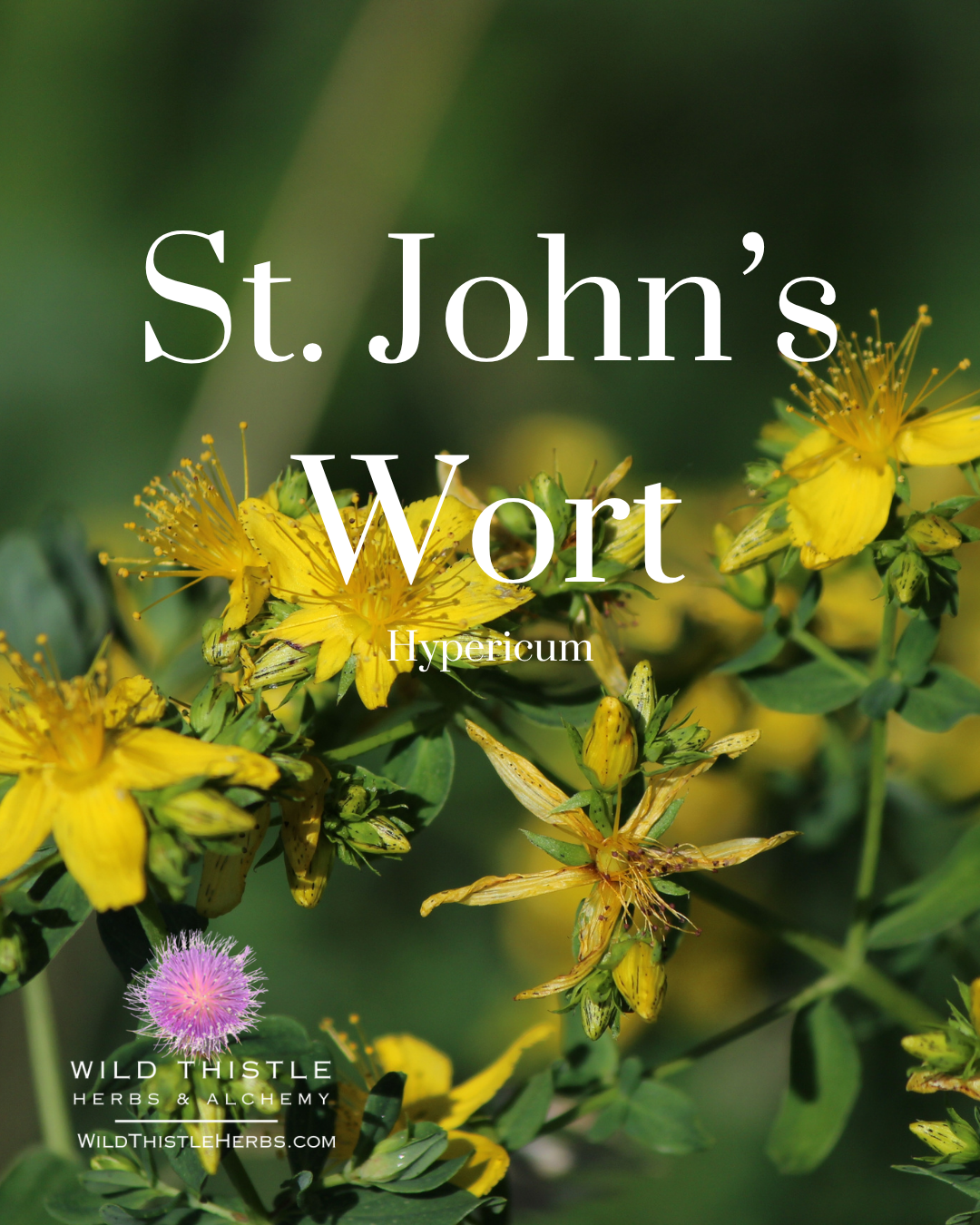
There is a plant whose very name carries the weight of midsummer fires, demon-chasing, and the protection of the home. She is shrubby and sun-loving, scattered with small star-shaped yellow flowers, and she has been woven into the fabric of human fear and hope for a very long time. She is St. John's Wort, and a small note worth making here: wort is simply an old English word for plant, one of those beautiful remnants of an older language still alive in the names we use today. Known to botanists as Hypericum perforatum, her story is one of the most layered in all of Herblore.
She is a plant that has known darkness and light in equal measure, and perhaps that is exactly why she became the plant people reached for when they needed to push back the darkness.
Hold her pale green leaves up to the light, and you will see something remarkable: tiny translucent dots scattered across the surface, making each leaf look as though it has been carefully perforated. It is one of her most distinctive features and the origin of her Latin name. Perforatum simply means perforated, a botanical nod to those luminous little windows in her leaves. When her flowers are infused in oil, something almost alchemical happens: the oil turns a deep, striking red, a transformation that has fascinated herbalists and curious minds for centuries.
Her botanical name, Hypericum, carries its own hidden story. It may derive from the Greek hyper (above) and eikon (image or icon), a reference to the old tradition of placing this plant above religious icons in the home to ward off evil. Even her name, it seems, is an act of protection.
She Was Noticed by the Ancients
St. John's Wort was recognized by the earliest herbal writers of the ancient world. Hippocrates in Greece and Pliny the Elder of the Roman Empire both knew her, which speaks to just how long she has been in conversation with humanity. She was present in ancient remedies and preparations across the classical world, a plant considered worthy of the most educated minds of her time.
A Plant of Midsummer
Her common name tells its own story. St. John's Wort takes her name from Midsummer, the time of year when she blooms most brilliantly and when, tradition held, her powers were at their peak. Her flowers and buds were gathered at Midsummer, later Christianized as St. John's Feast Day on June 24th, when it was believed that harvesting her at this sacred moment made her more potent. She was hung on house doors and stable doors on that day to ward off evil spirits and safeguard people and livestock from harm and sickness.
In France, it was customary to gather her before sunrise and then smoke her over the Midsummer bonfire, a ritual believed to intensify her protective gifts. In Wales, the roots were dug up on Midsummer's Eve and hung above doorways to bring luck into the home. She was also used for love divination at Midsummer, consulted by those who hoped to glimpse the face of a future beloved in her petals.
Her many folk names reflect the reverence and fear she inspired. She has been called fuga daemonum, loosely translated as demon-flight, as well as devil's scourge and Lord God's wonder plant. In various English counties she carried names like balm of the warrior's wound in Somerset, rosin rose in Yorkshire, and touch-and-heal in Northern Ireland.
The Plant That Kept Darkness Away
The belief that St. John's Wort could drive away evil is ancient and widespread. The ancient Greeks believed she could chase away evil spirits entirely. In medieval England, she was used to protect against demon attacks and recover from them. She was placed under pillows at night to keep witches away while people slept, and throughout the British Isles she was trusted to guard against witches, wicked spirits, and faeries. In the Middle Ages, she was hung inside homes for protection against misfortune and harm.
There is something poignant in this, that in a world where fear was constant, whether fear of enemies, famine, illness, injury, or simply the great unknown, people reached for this small yellow-flowered plant and trusted her to hold the darkness at bay.
Her Magic Today
St. John's Wort carries rich magical associations that continue in modern practice. She is a plant of protection and of light, called upon to brighten what feels heavy and to guard what feels vulnerable. She has long been a plant of Midsummer magic, tied to the sun, to fire rituals, and to the turning of the year toward warmth and light.
She reminds me that the plants people have turned to in moments of fear and uncertainty are not accidental choices. There is wisdom in what the old traditions reached for, even if the language they used to describe it was different from our own.
She has been held above sacred icons and burned over Midsummer fires. She has been tucked under pillows and hung above thresholds. She has been trusted by Hippocrates and whispered over by village healers. She is Hypericum perforatum, St. John's Wort, and she has been keeping watch over the human heart for a very long time.
Visit the Apothecary
If St. John's Wort's story has called to you, I invite you to stop by the apothecary or reach out to learn more about the plants I work with and the offerings available. I would love to connect with you.