Dandelion
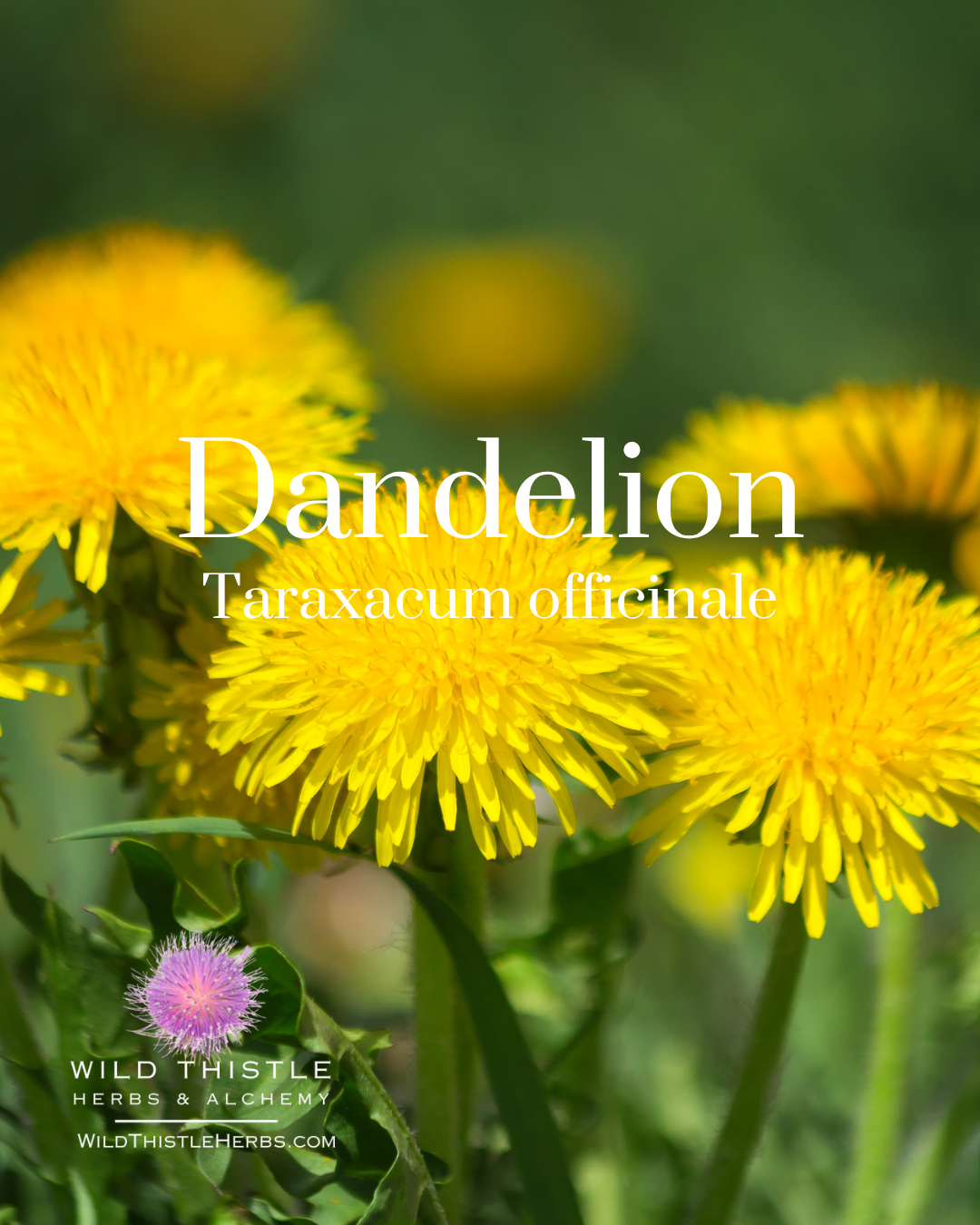
Herblore is a recurring series here on the Wild Thistle blog where I explore the history, folklore, and magic of the plants I love and work with. Each entry is an invitation to see the herbs around you a little differently, not just as ingredients, but as ancient companions with stories worth remembering.
HERBLORE: Dandelion
There is a plant that many people spend a great deal of energy trying to get rid of. She pushes up through sidewalk cracks and spreads across carefully tended lawns with cheerful, absolute indifference. She is bright yellow, bold, and utterly unbothered by what anyone thinks of her. She is dandelion, and she has something important to teach us about letting go.
I want to start by saying something in her defense: dandelion is not a weed. She’s just a gorgeous plant that grows where she is not invited. Her tenacity is remarkable; she comes back no matter how many times she is pulled. She ensures we’ll see her offspring by seeding herself across the wind with breathtaking efficiency and simply begins again somewhere new. She is, in the truest sense, a plant that cannot be controlled, and I find that rather magnificent.
Her botanical name is Taraxacum officinale, and she has been keeping company with humans for a very long time. The ancient Egyptians, Greeks, and Romans all knew her. Traditional Chinese medicine has been used with her for over a thousand years. She was likely brought to North America on the Mayflower, carried by people who valued her enough to pack her among their most essential provisions for a new world. She grows on every continent except Antarctica, which says a lot about how deeply she is committed to being part of the human story.
What's in a Name
Her common name, dandelion, is borrowed from the French dent de lion, meaning lion's tooth, a nod to the deeply toothed edges of her leaves. Her Latin name, Taraxacum, traces back through Arabic and possibly Persian roots to a phrase meaning bitter herb, which is fair. She is bitter, particularly as the season wears on and the leaves mature.
But she has carried other names too. Blowball, for obvious reasons. Puff-ball. Witch's gowan. Priest's crown. And, in both French and Old English, names that allude to her long-known affinity for encouraging things to move and flow through the body. The French called her pissenlit, which translates to English as pee-a-bed, both of which point directly to her well-established reputation as a plant with a strong diuretic nature. She moves things along. She restores flow. I think about that often when I consider her magical associations with releasing and letting go. It is not only metaphor. She has always been a plant that helps things move.
The Whole Plant is the Medicine
In herbalism, we work with all of her. The young, tender leaves are excellent in a salad in early spring, when they are at their mildest, and the bitterness has not yet fully set in. The flowers are edible too, cheerful additions to a spring table. The roots carry their own gifts. She offers herself completely, holding nothing back, which feels very much in keeping with who she is.
A note about safely harvesting her: do so only from a place you know has not been treated with pesticides or herbicides. She absorbs what is in the soil around her, and what you want is the clean, wild version of her, not whatever the neighbors sprayed on their lawn last Tuesday.
A Plant That Cannot Be Stopped
One of the things I love most about dandelions is how they propagate. Her seeds, those perfect white spheres that follow the yellow bloom, are engineering marvels. Each tiny seed is attached to a feathery parachute designed to create its own unique airflow, lifting and carrying it on the wind. Dandelion seeds can travel up to a hundred kilometers from the parent plant, and the pappus, that delicate white structure, can even adjust its shape based on air moisture, closing up in damp conditions to wait for better flying weather before releasing.
She does not depend on any other creature to spread; she simply waits for the right moment and then lets go.
The Wish and the Letting Go
Blowing a dandelion and making a wish is one of those pieces of folk magic so deeply embedded in childhood that most of us have done it without ever thinking of it as magic at all. And yet it is. You hold something you want, breathe your intention into it, and then release it to the wind. You let go of the outcome. You trust that what you have sent out will find its way.
Dandelion has long been associated with wishes, psychic ability, intuition, and spiritual and emotional cleansing. She sits at the intersection of the seen and the unseen, the earthly and the ethereal, the held and the released.
She reminds us, gently and persistently, that we cannot control everything. No matter how carefully we tend our gardens, no matter how tightly we grip our plans and our outcomes, dandelion will find a crack and grow there anyway. She is a plant-shaped reminder that ease and flow are not things we manufacture through control. They are what remains when we release it.
A Releasing Ritual
Dandelion is a beautiful companion for releasing work, for those moments when you are ready to let something go: an old wound, a pattern that has outstayed its welcome, self-judgment that has been weighing on you longer than it should.
Here is a simple practice I love doing. You will need a piece of paper, something to write with, a tablespoon or so of dried dandelion petals, and a fireproof dish with matches or a lighter.
Take a few quiet breaths and settle into your body. When you feel ready, write down what you are releasing. Be honest. Be specific. After you’ve written what needs to be released, lay the paper flat and sprinkle the dandelion leaves and petals over your words, visualizing them filled with loving, healing light. Hold your hands above the paper and feel the dandelion's bright energy rising toward you, drawing the heaviness up and away from your heart. When you feel complete, fold the paper, just enough so the petals stay inside, and place it in your fireproof dish. Light it. Watch the fire transform the words and the weight into smoke and ash. Take the cooled ash outdoors and release it.
Let it go the way a dandelion always does. Completely. Trustingly. On the wind.
Her Magic Today
Magically, the dandelion is associated with wishes, courage, psychic ability, intuition, and spiritual and emotional cleansing. She is a plant that supports the work of releasing what no longer serves: old grief, self-judgment, accumulated negativity. She restores ease. She restores flow. She is, in the quietest and most persistent way, a plant of renewal.
She has been dismissed as a weed by people who did not understand her. She has been eaten at tables across cultures for centuries. She has been blown into the wind by children who instinctively understood that there was magic in the letting go.
She is dandelion, and she will be back next spring whether you invite her or not. I think that is the whole point.
Visit the Apothecary
If dandelion has called to you, I would love to talk about ways to work with her. Stop by the apothecary or reach out to learn more.
These statements have not been evaluated by the Food and Drug Administration. This product is not intended to diagnose, treat, cure, or prevent any disease.