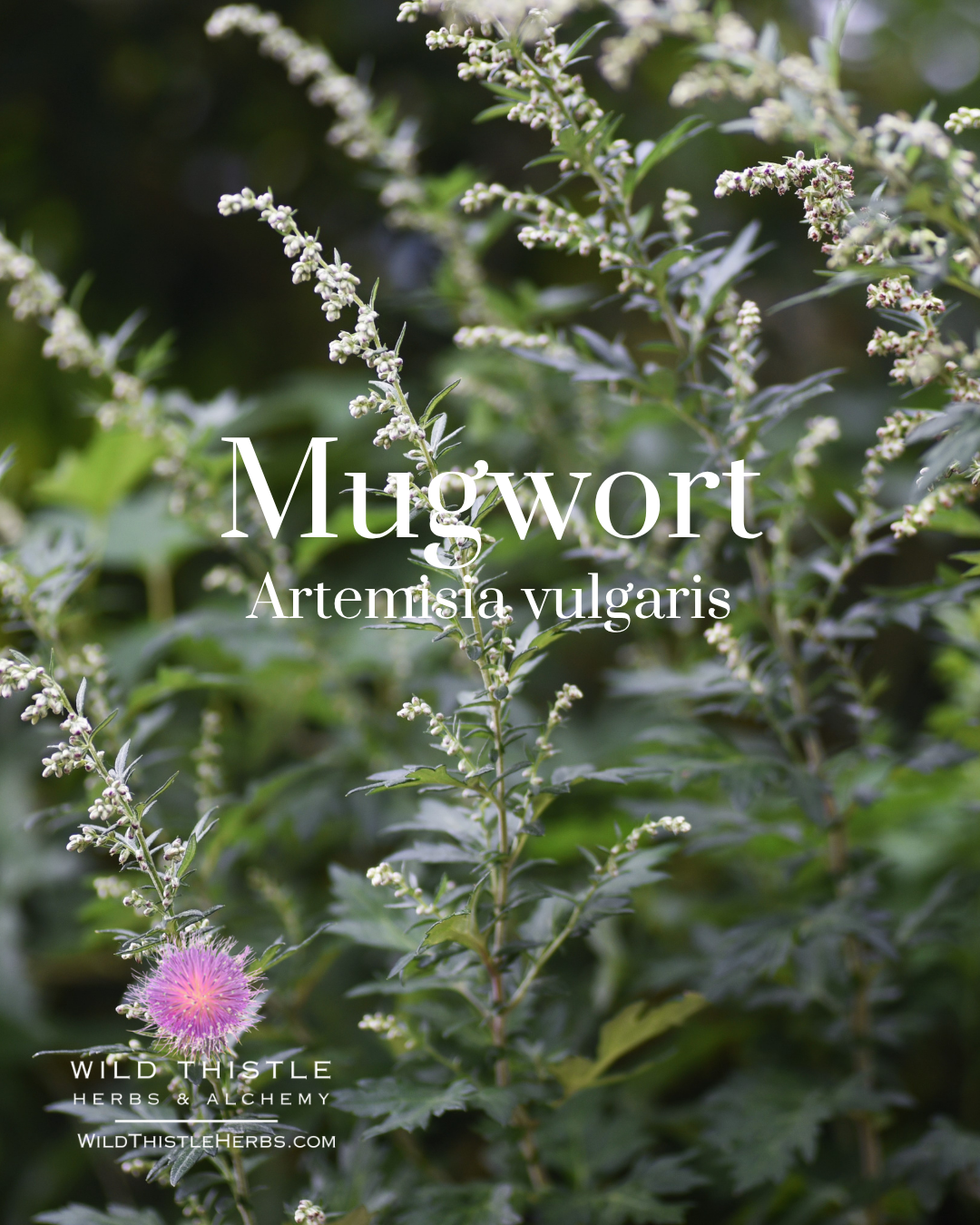
Mugwort
Herb Lore is a recurring series here on the Wild Thistle blog where I explore the history, folklore, and magic of the plants I love and work with. Each entry is an invitation to see the herbs around you a little differently, not just as ingredients, but as ancient companions with stories worth remembering.
There is a plant that has walked beside dreamers, travelers, and seers for as long as anyone can remember. She is aromatic and a little wild, silver-leafed and deeply mysterious. She is mugwort, and she has been whispering to the unseen world on our behalf since long before written history had words for what she does.
Artemisia vulgaris
Let’s start with her name, because it holds more than you might expect.
Her botanical name is Artemisia vulgaris, and she is named for Artemis, the Greek goddess of the hunt and the moon, patron of women, symbol of strength and untamed independence. That naming was not accidental. Mugwort has always been a plant of the feminine, of the moon, of the liminal spaces where the ordinary world brushes up against something older and wider.
Her common name has its own interesting story. The Old English name mucgwyrt may trace back to words meaning marsh plant, or possibly to an even older root connected to the midge, the small winged creature she was long believed to repel. Wort, as we discussed earlier in this series, is simply an Old English word for plant. She is, in the most literal sense, the plant of the marsh and the moon.
The Mother of Herbs
During the Middle Ages, mugwort was known as the mother of herbs, a title that speaks to just how central she was to the herbal traditions of that era. She was not one plant among many. She was the one from whom so much else grew, respected and called upon across European, Chinese, and Hindu traditions alike. That title was earned over centuries of use, reverence, and quiet trust.
The Moon on Her Leaves
Look closely at mugwort, and you will notice something: the underside of each leaf is pale, almost silvery, covered in fine downy hairs that seem to catch the light in a particular way. In the old traditions, this silver side was said to mirror the moon's own light, a physical signature of her deep lunar nature. Plants that carried silver leaves or bloomed by night were considered especially magical, and mugwort, with her moonlit undersides, was no exception.
She is aromatic, slightly bitter, and unmistakable once you have encountered her. She has been used as an ingredient in incense across East Asia for centuries, burned in Japan, China, and Korea, her fragrance carrying its own kind of magic through the smoke.
The Dreamer's Herb
If mugwort has one reputation that has followed her most faithfully across cultures and centuries, it is this: she is the dreamer's herb.
She has long been associated with vivid, prophetic dreaming, the kind of sleep that feels like it is taking you somewhere meaningful rather than simply resting you. Victorian crystal gazers in England were said to drink mugwort tea before their sessions to sharpen their perception and heighten their abilities. Whether they were gazing into a crystal ball or simply into the quiet of their own inner knowing, mugwort was the plant they reached for to make the veil a little thinner.
This is not surprising when you consider her deep connection to the moon, to the night, and to the world that lives just on the other side of our ordinary awareness.
A Plant of Protection on the Road
Mugwort has also long been a traveler's companion. Roman soldiers are said to have placed mugwort in their sandals on long marches, trusting her to protect their feet against the weariness of the road. Throughout the British Isles, she was carried as a protective charm for those journeying far from home, believed to guard against evil spirits and the dangers of the night.
She was also thought to prevent fairy meddling, which I find wonderfully specific. Not faeries in general, not the Otherworld at large, but the particular action that faeries are known for. And yet in a beautiful contradiction that feels very true to how plant lore works, faeries were also said to use mugwort themselves in their own travel spells. She is, it seems, useful on both sides of that particular conversation.
The Nine Herbs Charm and St. John's Protection
Mugwort holds a place of honor in the Anglo-Saxon Nine Herbs Charm, a tenth-century text that called upon nine sacred plants for protection and healing. She was considered one of the most powerful protective plants in the Old English tradition.
In the Middle Ages, she was known as cingulum Sancti Johannis, the girdle of St. John, after the legend that John the Baptist wore a girdle of mugwort in the wilderness. A crown woven from her stems was said to be worn on St. John's Eve for protection against evil. In Holland and Germany, she was called St. John's plant, and it was believed that gathering her on that sacred evening gave her particular power against misfortune and harm.
On the Isle of Man, she is still worn on the lapel at the Tynwald Day celebrations to this day, a living thread of tradition stretching back through centuries of folk practice.
A Sacred Plant in Nepal
In Nepal, mugwort holds a living ceremonial role that continues to this day. She is offered to the gods, used to cleanse and bless the home, and hung outside in bundles to purify the space around the dwelling. There is something deeply moving about a plant whose protective and sacred reputation has traveled across so many cultures, for so many centuries, and is still used today.
Her Magic Today
In folk magic, mugwort is often reached for in practices. She is called upon to enhance prophetic dreams, sharpen intuition, provide psychic protection, and support love, luck, and connection with spirit guides. She is a plant for those who are willing to pay attention, to slow down at the edge of sleep and notice what is waiting there. She rewards a quiet, receptive presence with the kind of knowing that does not always come in words.
She has been worn in sandals on Roman roads and woven into crowns for sacred evenings. She has been burned in temple incense and tucked into charm bags. She has been the companion of crystal gazers and the ally of travelers and the guardian against fairy mischief. She has been named for an ancient goddess.
She is mugwort, the dreamer's herb and the mother of herbs, and she has been walking the edge of the unseen world alongside us for a very long time.
Visit the Apothecary
If mugwort has caught your attention, I would love to talk plants with you. Stop by the apothecary or reach out to learn more about working with her and the other plants I love.