Frankinsence
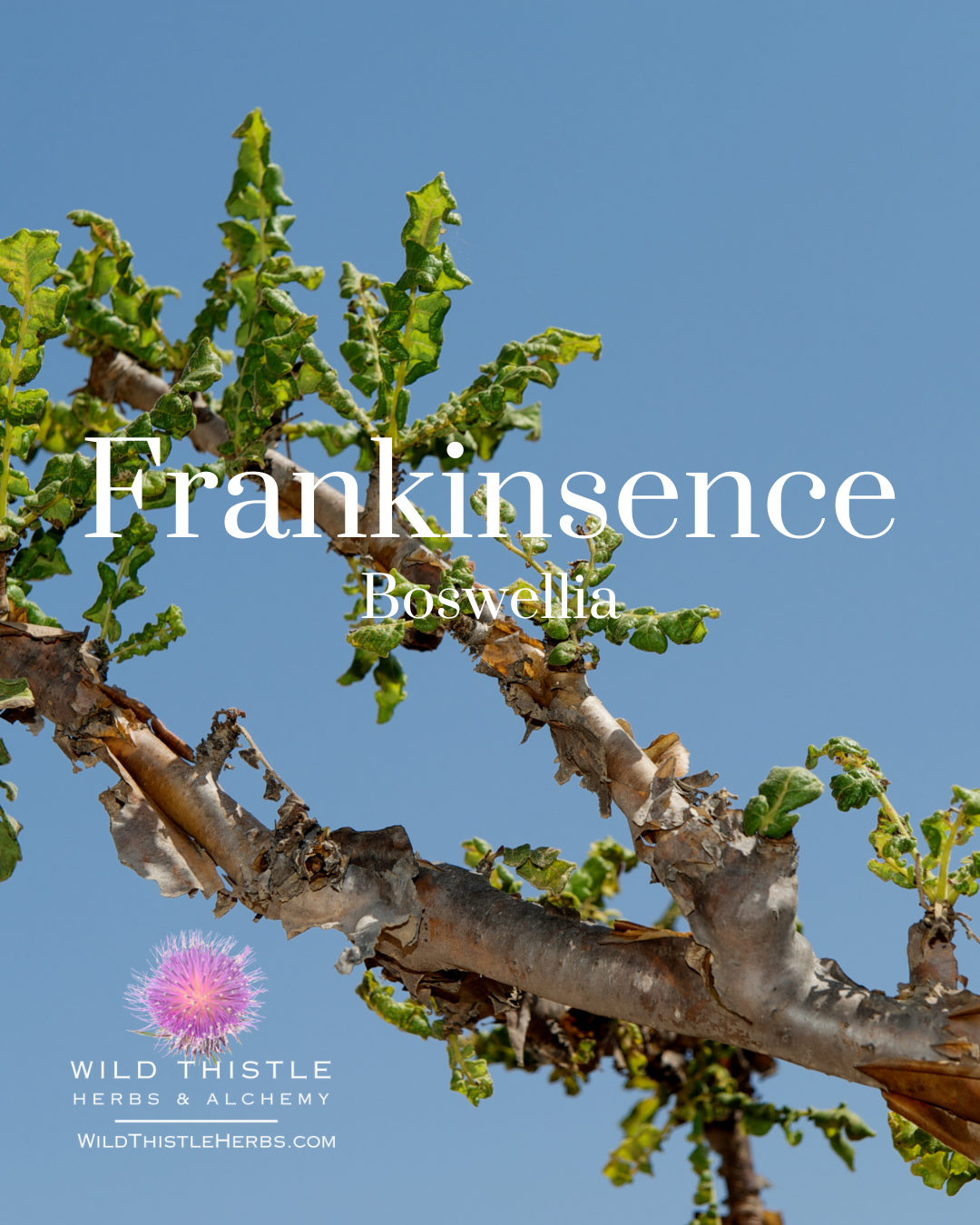
There is a resin so ancient, so sacred, and so deeply woven into the story of human devotion that it has been carried to the altars of gods across cultures and continents for thousands of years. Its smoke has risen in Egyptian temples, Greek sanctuaries, Chinese monasteries, and medieval cathedrals alike. It is frankincense, and its story is one of the most extraordinary in all of Herb Lore.
________________________________________________________________
Frankincense does not come from a leaf or a flower or a root. It comes from a tree, a striking one, with papery peeling bark and dense branches that look almost sculptural against the dry, sun-bleached landscapes it calls home. To harvest the resin, the bark is carefully cut, and the sap that flows out is left to harden into what are called tears, small amber-colored pieces that carry one of the most transporting scents the natural world has ever produced. The resin is hand-sorted for quality, a practice as unhurried and intentional as the traditions it has always served.
Its name holds its history. Frankincense comes from the Old French franc encens, meaning true incense or pure incense. This was not an ordinary offering. This was the finest smoke that devotion could provide.
A Resin Older Than Written History
Frankincense has been traded across the Arabian and Somali peninsula for more than five thousand years, which means it was moving along ancient trade routes long before most of the world's great religions had taken shape. It crossed deserts on camelback and traveled sea routes that connected civilizations who shared almost nothing else in common. And yet all of them, somehow, found their way to frankincense.
The Greek historian Herodotus wrote about the trees of southern Arabia from which this precious resin came, noting that they were said to be guarded by winged serpents, creatures that had to be driven away with smoke before the harvest could begin. Whether that is history or legend hardly matters. What it tells us is that even in antiquity, people understood that frankincense was something worth protecting.
Sacred to Gods Across the World
What moves me most about frankincense is how universally sacred it became among cultures that did not know of one another. The Egyptians burned it in religious ceremony, trusting that its smoke carried their prayers upward and opened a channel of communication with the divine. The Greeks and Romans offered it on their altars. In China and India, it has burned in temples for centuries as an aid to meditation, its smoke a visible thread between the human and the sacred.
In the ancient Hebrew tradition, frankincense was prescribed as a holy offering, blended with other aromatic resins and burned before the Ark of the Covenant. It was not a sensory pleasure. It was an act of devotion, serious and deliberate.
In the Christian tradition, it is one of the three gifts carried by the Magi to the nativity, alongside gold and myrrh. Its place in that story speaks to how deeply its sacred meaning was understood across the ancient world. It is also associated with some of the most luminous figures in the ancient pantheon: Aphrodite, Apollo, Helios, Ra, and Venus. Burning frankincense signaled that what was happening in that space was worthy of divine attention.
Evil Spirits, Ritual Circles, and Good Luck
Across Europe, frankincense gathered its own protective folklore. In Germany, it was believed to have the power to scatter evil spirits, and that reputation followed it into medieval magical practice. In that era, it was used to fumigate divinatory mirrors and to mark the boundaries of ritual circles, the smoke acting as an active protection between the sacred and whatever lay outside it.
It was also simply carried for luck, one of those quiet crossover moments where the ceremonial becomes personal. People wanted frankincense close not just in formal ritual but in the rhythms of daily life, a small amber charm against uncertainty and harm.
Her Magic Today
Magically, frankincense is one of the most expansive and versatile resins in practice. She is called upon for clarity and awareness, for banishment and protection, for courage and focus. She supports dream work and psychic abilities, happiness and blessing, concentration and defense. She is a plant of the threshold, equally suited to opening sacred space and sealing it again, to the deepest meditative work and the most grounded everyday ritual.
There is something that stays with me about frankincense: that the same resin burned in the temples of ancient Egypt can still be found in apothecaries and personal practice today. She does not belong to one tradition or one people. She belongs to something older and wider than any single faith or culture, to the deep and universal human impulse toward the sacred, the desire to send something beautiful upward and trust that it will be received.
She has been carried across deserts and traded across oceans. She has burned on altars dedicated to gods whose names we barely remember and in cathedrals that are still standing. She has been a gift fit for the divine and a small charm carried in a pocket for luck on an ordinary day.
She is frankincense, and her smoke has been rising toward the heavens for longer than any of us can fully imagine.