Hawthorn
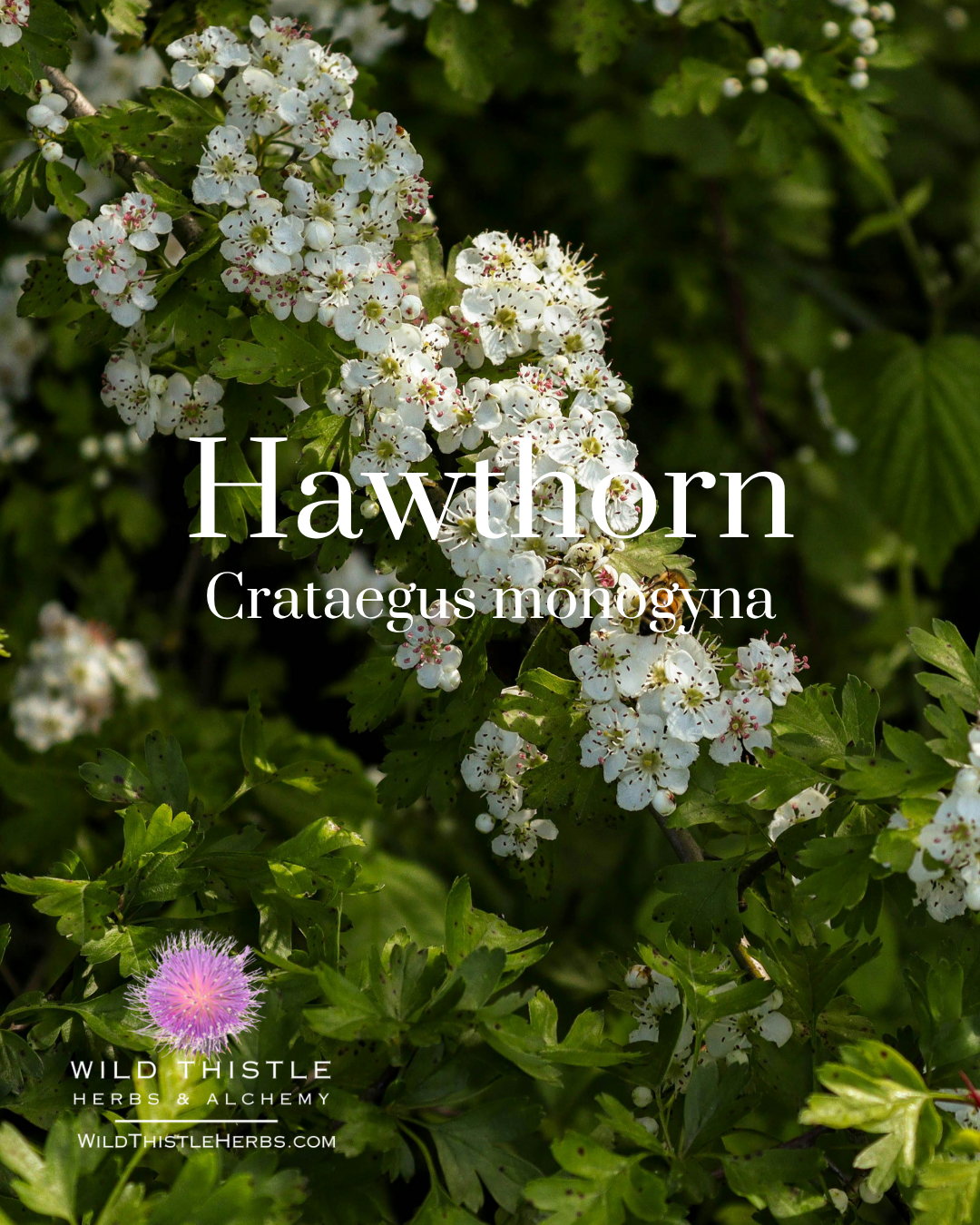
Herb Lore: Hawthorn
Herb Lore is a recurring series here on the Wild Thistle blog where I explore the history, folklore, and magic of the plants I love and work with. Each entry is an invitation to see the herbs around you a little differently, not just as ingredients, but as ancient companions with stories worth remembering.
There is a tree that stands at the threshold of two worlds. She is thorned and tender, wild and deeply rooted, beloved by faeries and farmers alike. She blooms in May and burns red in autumn, and she has been woven into the spiritual life of humanity for longer than most of us can begin to trace. She is hawthorn, and she is one of my very favorites.
I want to begin by noting that the ancient Celts understood in their bones that trees are not background. They are not scenery. They are beings, sentient and sacred, and the Celts placed them at the very center of their universe. Trees were the foundation of their culture, stories, and their most sacred rituals. They believed trees served as gateways to the spiritual Otherworld, and hawthorn held a place of particular power in that belief. She was not simply a tree. She was a doorway.
That reverence has never fully left us. It lives on in ways we might not even notice.
A Tree You Do Not Cut Down
In England and Ireland, cutting down a hawthorn, especially one standing alone in a field, is still considered a very serious matter. Farmers have been known to plow around a solitary hawthorn tree rather than disturb her, a quiet act of respect that stretches back through centuries of folk belief. The superstitious dread of harming her may be connected to an old belief that lone hawthorns, those self-seeded trees standing apart from all others, were touched by lightning and offered protection against it. Whatever the reason, people have always known, somewhere deep in their knowing, that hawthorn deserves to be left standing.
There is a story that speaks to just how seriously this is taken in modern times. When the DeLorean Motor Company built its production facility in Northern Ireland, a hawthorn tree was removed to make way for construction. Folklorists and locals alike quietly noted that the company's legendary string of misfortunes followed not long after. Whether you believe in such things or not, it is a story worth sitting with.
The Tree of the Fae
If hawthorn belongs to any realm beyond our own, it is the realm of the faeries. In Gaelic folklore, hawthorn marks the entrance to the Otherworld and is so deeply tied to the Fae that to disturb one lightly is to invite their displeasure. And yet she is also celebrated. During Beltane, it is traditional to decorate hawthorn as a May bush, a festive and joyful honoring of her presence in the turning of the year.
The faeries are said to dance around hawthorn trees, particularly those standing alone in a field. Another reason not to cut one down. I find myself thinking about those solitary trees, wondering what they have witnessed over the years, what invisible celebrations have spun around their roots in the moonlight.
She is known by many names: quickthorn, whitethorn, May-tree, thornapple, and hawberry among them. Her botanical name, Crataegus, comes from the Greek words for “strength” and “sharp,” a nod to her sturdy wood and formidable thorns. The name haw itself comes from an old Anglo-Saxon word for hedge, which tells you something about how central she has been to the physical shaping of the landscape, particularly in Britain, where hawthorn hedgerows have defined the countryside for centuries.
Hope, Weddings, and the May
Hawthorn has long been considered an emblem of hope. The ancient Greeks carried her flowering branches in wedding processions and used them to decorate the altar of Hymenaios, the god of wedding ceremonies. She was a plant of celebration and promise, tucked into the happiest moments of human life.
In Scotland, there is an old saying: Ne'er cast a cloot til Mey's oot, which is a gentle warning not to put away your winter clothing until the hawthorn's May blossoms are fully open. She was so tied to the rhythm of the seasons that she became a marker of time itself.
In the Victorian language of flowers, hawthorn meant hope. It was once said that she could heal a broken heart, and I believe it. That old folk wisdom feels true to me in a way that goes beyond superstition.
The Glastonbury Thorn
One of the most enduring stories woven around hawthorn is that of the Glastonbury Thorn, a particular variety that flowers twice a year, once in winter and once in spring. Legend holds that this remarkable tree grew from the walking staff of Joseph of Arimathea, planted into the ground at Glastonbury in Somerset, England. The original tree was lost during the English Reformation, but cuttings survived, and the tradition of sending a sprig of the Glastonbury Thorn's winter blossoms to the British monarch each Christmas has continued since the reign of King James I. A piece of living legend, delivered to a royal table year after year.
Hawthorn and the Vampire
And then there is this remarkable piece of folklore, which I love for its sheer unexpectedness: in Serbian tradition, a stake made of hawthorn wood was considered essential for slaying vampires. Her thorned and protective nature, so long associated with guarding thresholds and keeping harm at bay, extended in the Balkan imagination to the most dramatic form of protection possible.
Her Magic and Her Heart
In folk magic, Scott Cunningham associates hawthorn with protection, love, and happiness. She is a plant of Beltane, of the Otherworld, of the threshold between what is seen and what is not. She is carried for luck and woven into protective charms. She is a guardian and a celebrant, equally at home marking a doorway against harm and decorating a wedding altar with hope.
On a personal note, hawthorn is one of the plants I reach for again and again, both for myself and for those I work with. I often serve her in the shop and at classes, and the way I think about her is this: she is a warm-hearted hug. When something tender in you needs tending, when the heart is carrying more than it should, when you need to feel held rather than fixed, hawthorn is who I call on. She works on a spiritual and emotional level in a way that I find quietly extraordinary.
She is thorned, and she is gentle. She guards the threshold, and she opens the door. She dances with the Fae in moonlit fields, and she keeps watch over the ordinary farmer's land.
She is hawthorn, and she has been holding the line between the seen and the unseen world for as long as the old stories can remember.
Visit the Apothecary
If hawthorn has called to you, I would love to share her with you. She is one of the plants I keep close and serve regularly in the apothecary and at classes. Stop by or reach out to learn more about working with her.
These statements have not been evaluated by the Food and Drug Administration. This product is not intended to diagnose, treat, cure, or prevent any disease.