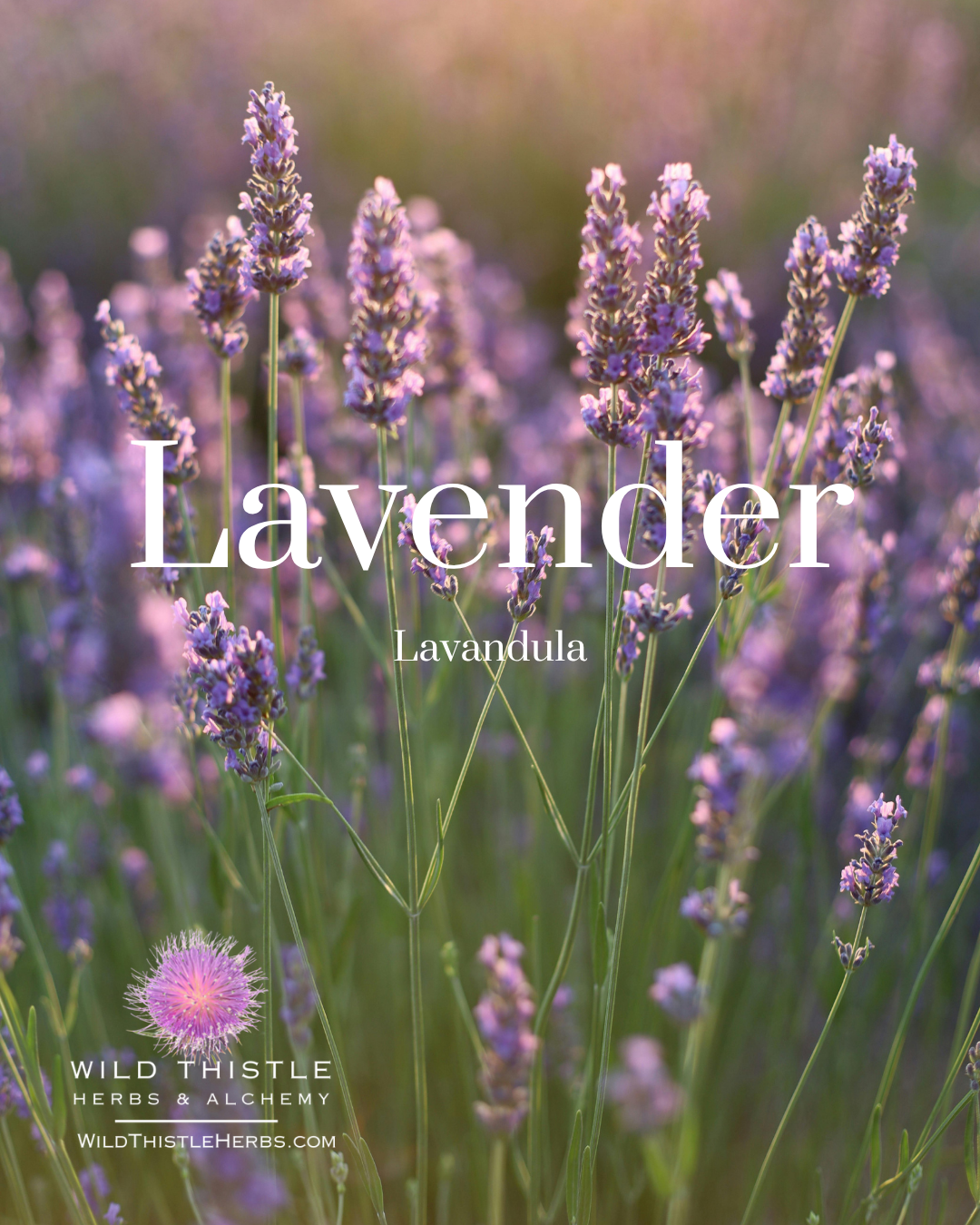
Herblore is a recurring series here on the Wild Thistle blog where I explore the history, folklore, and magic of the plants I love and work with. Each entry is an invitation to see the herbs around you a little differently, not just as ingredients, but as ancient companions with stories worth remembering.
HERBLORE: Lavender
One of the Most Famous Aromatics
There is a plant so deeply familiar she has become shorthand for calm itself. Her color is named after her. Her scent is unmistakable. She is lavender, and she has been woven into human life since long before we had words to fully describe why we loved her so much.
She is native to the sun-warmed, wind-kissed shores of the Mediterranean, a plant that has always loved dry, sandy soil and wide open skies. Her name carries her history inside it: lavender descends from the Latin lavare, meaning to wash, a nod to her ancient role scenting the bathwater of Greeks and Romans who valued cleanliness and fragrance in equal measure. In Roman times, lavender flowers were so prized they sold for 100 denarii per pound, roughly a month's wages for a farm laborer. She has never been a plant people took lightly.
The ancient Greeks knew her by a different name entirely. They called her nardus, after Naarda, a city in Syria near the Euphrates, and she was considered a thing of great value, mentioned by St. Mark as spikenard. She traveled far and wide across the ancient world, carried by trade routes and tucked into the belongings of those who could not imagine being without her.
A Plant of the Wash and the Home
From the very beginning, lavender has been a plant of the home. She was used to scent laundry and linens in ancient Greek and Roman times, tucked among stored clothing to keep them fresh and fragrant. That tradition has never really left us. Many people still keep dried lavender sachets in their drawers and closets today, following a custom that is thousands of years old without even knowing it.
Across many cultures and across centuries, lavender has been brought into homes simply because she makes them smell beautiful. This is not a small thing. The desire to fill our spaces with something lovely and aromatic is one of the most human impulses there is, and lavender has been answering that call for a very long time.
Royalty and Reputation
Queen Elizabeth I of England is said to have prized lavender conserve so highly that it was kept at her table as a regular fixture, which tells you something about the regard in which she was held at court. She was not simply a garden plant or a peasant's remedy. She was fit for a queen.
During the Middle Ages, lavender was associated with love and considered an aphrodisiac, a reputation that traveled widely. I will be honest: I have always wondered whether that reputation had something to do with the fact that bathing was not exactly a daily practice in medieval Europe. A person who smelled of lavender would have stood out in the most appealing way imaginable. Whatever the reason, the association between lavender and desire was taken quite seriously.
Some old herbal books mention lavender being worn by women of certain professions to advertise their trade, though most historians believe the more likely truth is that it was worn for protection, a shield of fragrance against a world that was not always kind.
Witches, Faeries, and Confusion
Like so many of the plants in this series, lavender gathered her share of protective folklore. In Wales, a sprig was worn for luck and sometimes for protection, because it was believed, for reasons no one could quite articulate, that lavender confused witches and evil spirits. I love that detail. Not that it repelled them, not that it drove them away, but that it simply confused them. There is something very charming about a plant whose magic works by bewildering the forces of darkness.
Her Magic Today
Magically, lavender is one of the most versatile plants in the practice. She is called upon to promote balance and harmony, to support dream work and divination, to cultivate calmness and intuition. Burned as dried leaves, she is said to release negativity and offer protection. She is associated with luck, purification, and, perhaps most beautifully, with the ability to see faeries, a reminder that her magic has always lived at the threshold between the seen and the unseen world.
She has scented the bathwater of ancients and the linens of queens. She has confused witches in Wales and perfumed the most coveted spaces in history. She is lavender, and she has been making the world a little more beautiful and a little more protected for as long as anyone can remember.
Visit the Apothecary
If lavender's story has called to you, I invite you to stop by the apothecary or visit the Etsy shop to explore the lavender offerings I have on hand. I would love to help you find the right way to bring her into your own home and practice.
This post shares history, folklore, and traditional uses for educational and cultural interest, and it is not medical advice. These statements have not been evaluated by the Food and Drug Administration. This product is not intended to diagnose, treat, cure, or prevent any disease. Please check with your qualified healthcare provider before using any herb.