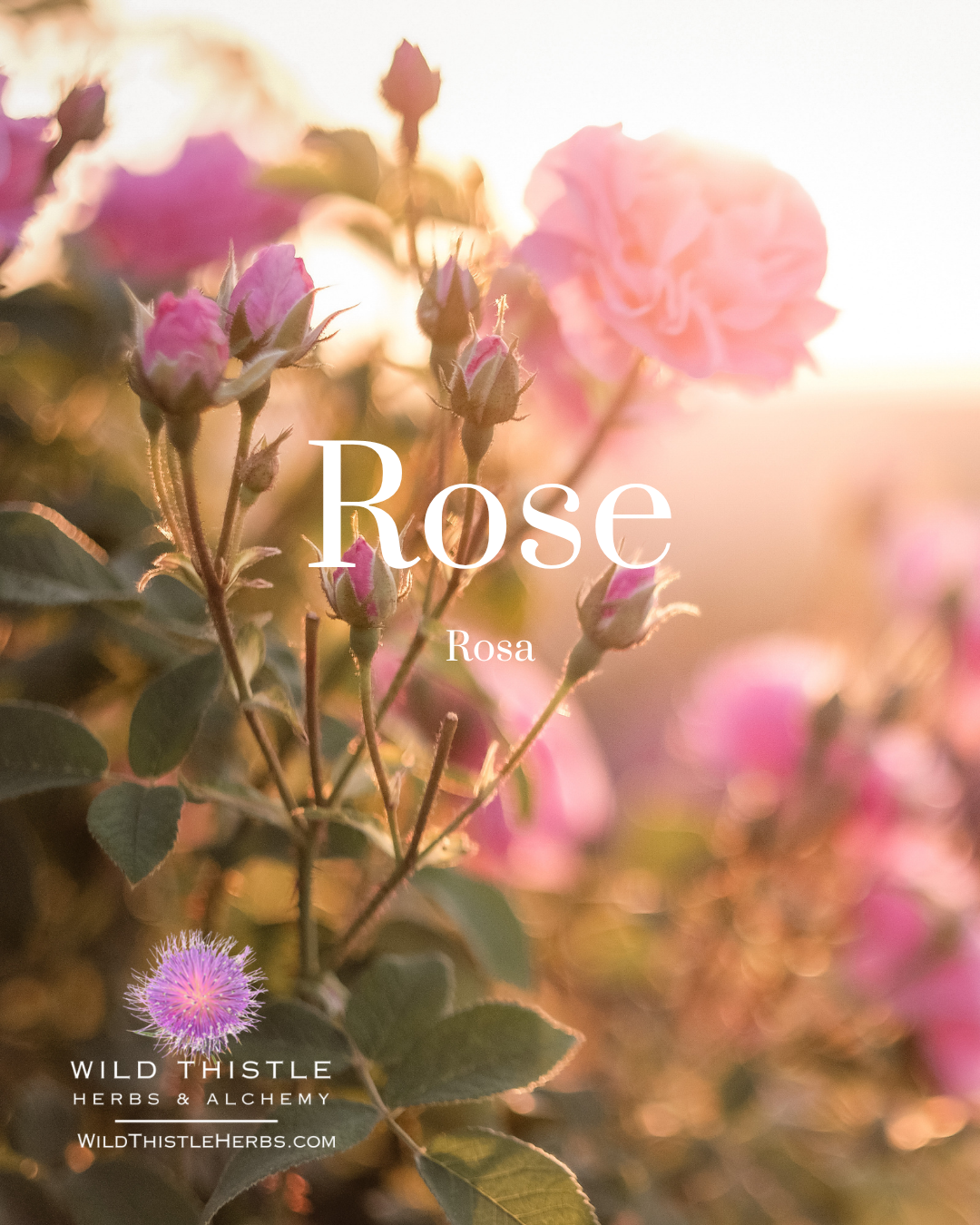
Rose
Herblore is a recurring series here on the Wild Thistle blog where I explore the history, folklore, and magic of the plants I love and work with. Each entry is an invitation to see the herbs around you a little differently, not just as ingredients, but as ancient companions with stories worth remembering.
HERBLORE: Rose
The Queen of Flowers
There is a plant so beloved, so ancient, and so deeply woven into the human story that she has been called the queen of flowers for as long as anyone can remember. Her perfume is legendary. Her symbolism runs centuries deep. She is rose, and she has never needed an introduction.
She is one of those rare plants that transcends every boundary, every culture, every era. She has been scattered across Roman streets and laid on Greek graves. She has perfumed the chambers of queens and been pressed between the pages of love letters. She has been grown in cottage gardens and palace courtyards alike, and everywhere she has gone, she has carried the same message: that beauty, love, and devotion are among the most powerful forces in the human heart.
She Has Always Known Power
Rose has been celebrated since antiquity for both her flowers and her hips, the small fruits that follow the bloom and carry their own quiet magic. The Romans used rose in their apothecaries and scattered her petals along the streets during festivals, a gesture of abundance and celebration. The Greeks wove her flowers into wreaths and placed them on graves, honoring the dead with her beauty.
Cleopatra, one of history's most legendary figures, is said to have received Mark Antony on a bed of roses, understanding instinctively what rose has always represented: desire, power, and devotion given physical form.
Rose and the Tudor Court
Few families in history claimed a plant as fully as the House of Tudor claimed the rose. Their family crest bore a red and white rose, a symbol of unity after the Wars of the Roses, and rose found her way into Tudor life in the most intimate of ways. Rose petals were dusted with sugar and eaten, considered an aphrodisiac at a court that understood the politics of love and desire all too well.
The Language of Color
It was the Victorians who gave rose her color language, the one that still shapes how we give and receive roses today. Red for passion. White for purity. Yellow for friendship, though also, with a twist of melancholy, for jealousy. In an era when emotions were rarely spoken aloud, the color of a rose said everything a person could not.
Her Magic
Magically, rose is most deeply tied to love and romance, her flowers long called upon to evoke desire and attraction. But her magic reaches further than that. Rose carries correlations with spiritual enlightenment, with the kind of love that moves beyond the romantic and into the sacred.
Rose hips hold their own place in magical tradition, associated with peace as much as love, and dried rose hips strung on a thread and worn as a talisman are said to attract love, affection, and serenity in equal measure. It is one of my favorite pieces of rose lore, the image of something so small and unassuming carrying such a tender and powerful intention close to the body.
She is a plant that asks us to open. To soften. To remember that love in all its forms, romantic, sacred, self-directed, is not a luxury but a necessity.
She has been scattered on streets and laid on altars. She has been worn by queens and whispered over by lovers. She is rose, the queen of flowers, and she has been holding the human heart in her thorned and tender hands since the very beginning.
In the Apothecary
If rose has called to you, I have a few offerings waiting. I keep rosebuds in the apothecary, beautiful and fragrant and ready to work with. I also craft a rose anointing oil, made by hand here in the apothecary, for those who want to carry her magic close. Stop by or reach out to learn more.
This post shares history, folklore, and traditional uses for educational and cultural interest, and it is not medical advice. These statements have not been evaluated by the Food and Drug Administration. This product is not intended to diagnose, treat, cure, or prevent any disease. Please check with your qualified healthcare provider before using any herb.